


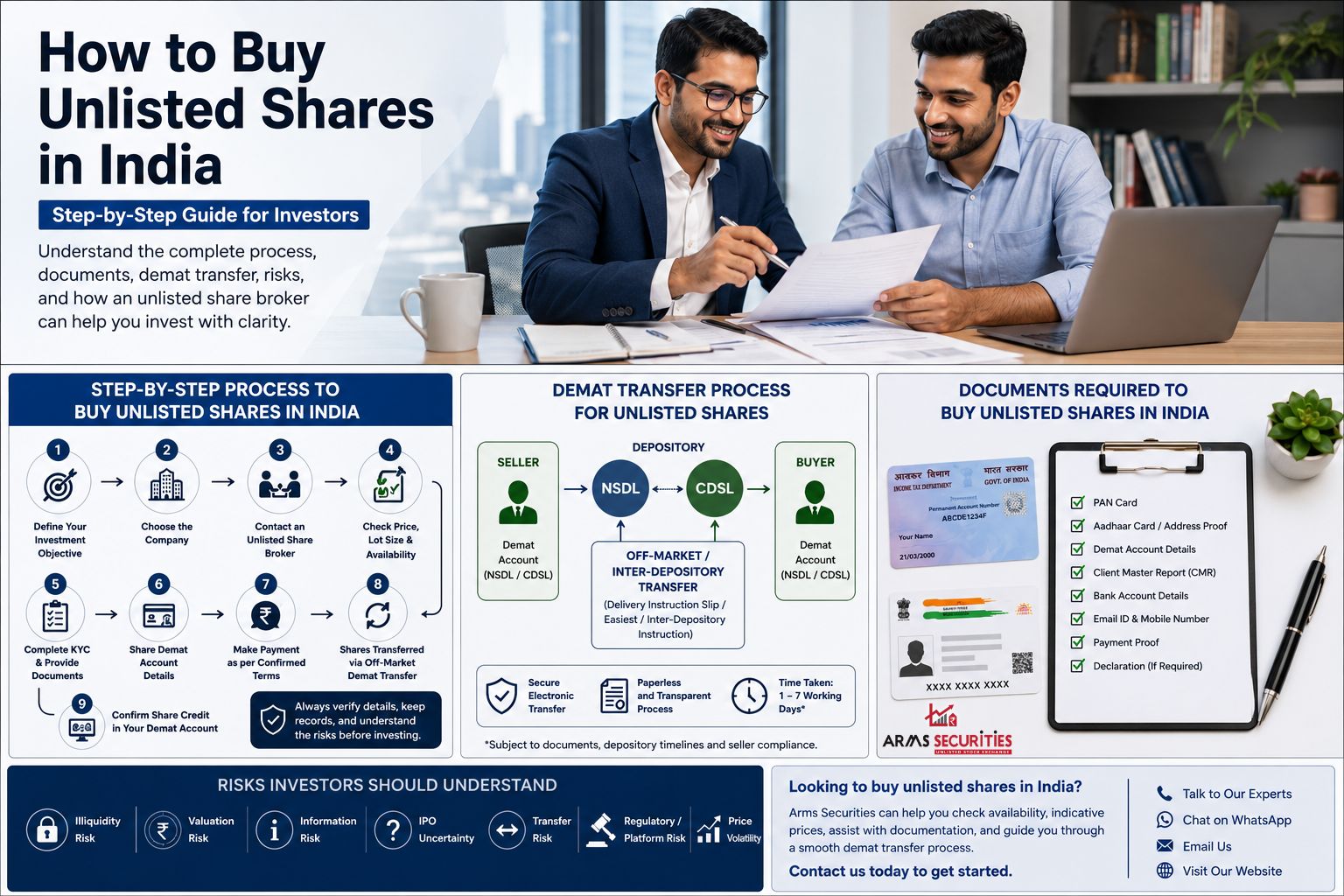
How to Buy Unlisted Shares in India: Step-by-Step Guide for Investors
Unlisted shares are becoming popular among Indian investors who want to explore opportunities beyond listed stock exchanges. Many investors search for pre IPO shares India, private company shares, unquoted shares, and high-growth companies before they enter the public market.
However, buying unlisted shares is different from buying listed shares on NSE or BSE. You do not simply open a trading app and place a market order. Instead, unlisted shares usually move through an off-market share transfer process using a demat account, proper documentation, seller availability, and price confirmation.
This guide explains how to buy unlisted shares in India, what documents you need, how demat transfer works, what risks you should understand, and how Arms Securities can assist you through the process.
Direct Answer: How Can You Buy Unlisted Shares in India?
You can buy unlisted shares in India through assisted off-market transactions where shares are transferred from a seller’s demat account to the buyer’s demat account. The process usually includes price confirmation, KYC, payment, documentation, and demat transfer through NSDL or CDSL, subject to share availability and seller verification.
What Are Unlisted Shares?
Unlisted shares are shares of companies that are not listed on recognized stock exchanges like NSE or BSE. These companies may be private companies, public unlisted companies, pre-IPO companies, or previously listed companies that are now delisted.
Examples of companies investors often track in the unlisted market include:
- Pre-IPO companies
- Financial services companies
- Depositories and exchange-related businesses
- Consumer brands
- Startup companies
- ESOP-held shares
- Delisted or illiquid securities
Since these shares are not traded like regular listed stocks, buying and selling happens through an off-market process.
Why Do Investors Buy Unlisted Shares?
Investors usually explore unlisted shares because they want access to companies before a possible IPO or public listing. Some investors also track unlisted shares for long-term wealth creation, portfolio diversification, or exposure to companies not available on stock exchanges.
Common reasons include:
- Access to pre-IPO opportunities
- Exposure to private or unlisted companies
- Long-term investment potential
- Interest in companies with strong business models
- Portfolio diversification beyond listed stocks
- Opportunity to invest before public market discovery
However, investors must also understand that unlisted shares carry higher risk. They may be illiquid, difficult to value, and harder to sell compared to listed securities.
Step-by-Step Process to Buy Unlisted Shares in India
Step 1: Understand Your Investment Objective
Before buying any unlisted share, ask yourself why you want to invest.
Are you investing for:
- Pre-IPO opportunity?
- Long-term holding?
- Portfolio diversification?
- Exposure to a specific company or sector?
- Future listing possibility?
This step is important because unlisted shares are not suitable for every investor. If you need short-term liquidity, regular price visibility, or easy exit options, unlisted shares may not fit your risk profile.
Step 2: Choose the Company You Want to Invest In
Once your objective is clear, shortlist companies based on:
- Business model
- Sector growth
- Financial performance
- Valuation
- IPO possibility
- Share availability
- Promoter background
- Recent news or corporate actions
- Risk factors
For example, some investors track companies in sectors such as financial services, exchanges and depositories, consumer brands, fintech, infrastructure, and technology.
A good unlisted share decision should not be based only on popularity. You should study the company’s financials, business strength, valuation, and liquidity.
Step 3: Contact an Experienced Unlisted Share Broker
Unlike listed stocks, unlisted shares are not available for regular exchange-based trading. Therefore, investors often work with an experienced unlisted share broker or intermediary who can help with availability, indicative price, documentation, and demat transfer guidance.
This is where Arms Securities can help investors with assisted support for buying and selling unlisted, pre-IPO, unquoted, delisted, and illiquid shares.
A reliable intermediary should help you understand:
- Whether shares are available
- Indicative buy price
- Lot size
- Seller availability
- Transfer process
- Required documents
- Risk factors
- Estimated transaction timeline
Avoid dealing with unknown sellers or platforms that promise unrealistic returns.
Step 4: Check Indicative Price and Availability
Unlisted share prices are not fixed like listed stock market prices. They are usually based on demand, supply, availability, recent transactions, company performance, IPO expectations, and seller interest.
Therefore, the price you see online may not always be the final transaction price.
Before proceeding, always check:
- Latest indicative buy price
- Minimum quantity or lot size
- Seller availability
- Payment terms
- Transfer timeline
- Any lock-in or transfer restriction
- Required documentation
The price should be confirmed before payment.
Step 5: Complete KYC and Document Verification
KYC and documentation are important for a smooth transaction.
Usually, buyers may need to provide:
- PAN card
- Aadhaar card or address proof
- Demat account details
- Bank details
- Client master report or CMR copy
- Mobile number and email ID
- Payment proof after transaction
- Any additional declaration, if required
The required documents may vary depending on the transaction type, company, seller, and intermediary process.
Step 6: Confirm Your Demat Account Details
A demat account is essential because unlisted shares are generally transferred in electronic form. The buyer must provide correct demat details so that shares can be credited properly.
Your demat details usually include:
- Depository name: NSDL or CDSL
- DP ID
- Client ID
- Beneficiary owner name
- ISIN of the security
- Quantity to be transferred
NSDL explains that for off-market transfer, the selling client gives a delivery instruction to the Depository Participant to transfer securities from the seller’s demat account. CDSL also provides its Easiest facility, through which eligible users can submit certain off-market and inter-depository transaction instructions online.
Step 7: Make Payment as Per Confirmed Terms
After price, quantity, seller availability, and documents are confirmed, the buyer makes payment as per the agreed terms.
Before making payment, always verify:
- Company name
- Share quantity
- Price per share
- Total transaction value
- Seller or intermediary details
- Bank account details
- Expected transfer timeline
- Refund or cancellation terms, if applicable
Do not transfer money based only on verbal commitments or social media messages. Keep proper records of payment and communication.
Step 8: Shares Are Transferred Through Off-Market Demat Transfer
After payment and documentation, the seller initiates the share transfer from their demat account to the buyer’s demat account.
This may happen through:
- Delivery Instruction Slip, also called DIS
- Online demat transfer facility
- CDSL Easiest, where applicable
- Inter-depository transfer if the buyer and seller use different depositories
If NSDL and CDSL accounts are involved, the transfer may require an inter-depository instruction. NSDL states that for debiting an NSDL beneficial account in an inter-depository transfer, the relevant inter-depository delivery instruction form is required.
Step 9: Confirm Share Credit in Your Demat Account
Once the transfer is completed, the buyer should confirm that shares are credited to the correct demat account.
Check:
- Company name
- ISIN
- Quantity
- Credit date
- Demat statement
- Transaction reference, if available
Keep your payment proof, communication, and demat credit confirmation safely for future tax, audit, or resale purposes.
Documents Required to Buy Unlisted Shares in India
The exact documents may vary, but buyers commonly need:
| Document | Purpose |
|---|---|
| PAN Card | Identity and tax verification |
| Aadhaar / Address Proof | KYC verification |
| Demat Account Details | Share credit |
| Client Master Report | Confirms demat account ownership |
| Bank Details | Payment and records |
| Email and Mobile Number | Communication |
| Payment Proof | Transaction record |
| Declaration, if required | Compliance and documentation |
For smooth processing, ensure that your name, PAN, bank account, and demat account details match correctly.
Role of Demat Account in Buying Unlisted Shares
A demat account plays a central role in buying unlisted shares. It holds your securities in electronic form and allows off-market transfer from seller to buyer.
In a normal listed stock transaction, the exchange, clearing corporation, broker, and depository systems handle the trade flow. In unlisted shares, the transfer is usually done outside the exchange mechanism through the demat system.
Your demat account helps with:
- Receiving unlisted shares
- Holding shares electronically
- Maintaining ownership records
- Transferring shares in future
- Tracking ISIN and quantity
- Supporting future sale or corporate actions
Before buying unlisted shares, ensure your demat account is active and your CMR copy is available.
How Price Discovery Works in Unlisted Shares
Price discovery in unlisted shares is different from listed shares.
Listed stocks have real-time prices on NSE or BSE. Unlisted shares do not have live exchange-traded prices. Their prices are usually indicative and depend on multiple factors.
Key factors include:
- Demand and supply
- Recent off-market transactions
- Company financial performance
- IPO expectations
- Sector outlook
- Investor interest
- Share availability
- Valuation compared to listed peers
- Liquidity conditions
- Seller urgency
This is why two brokers may show different prices for the same unlisted share. The final price depends on availability, negotiation, documentation, and transaction confirmation.
Risks Investors Should Understand Before Buying Unlisted Shares
Unlisted shares can offer interesting opportunities, but they also come with important risks.
1. Liquidity Risk
You may not be able to sell unlisted shares immediately. Finding a buyer can take time.
2. Valuation Risk
Since there is no live exchange price, valuation can be subjective. A high price does not always mean a good investment.
3. Information Risk
Unlisted companies may not provide the same level of public information as listed companies.
4. IPO Uncertainty
A company may plan an IPO, but listing is never guaranteed. IPO timing, approval, valuation, and market conditions can change.
5. Transfer Risk
Incorrect demat details, documentation errors, or seller-side delays can affect the transaction timeline.
6. Regulatory and Platform Risk
Investors should avoid unauthorized platforms or unrealistic promises. SEBI issued a caution in December 2024 about transactions in unlisted public company securities on unauthorized electronic platforms, saying such platforms are neither authorized nor recognized by SEBI.
7. Price Volatility
Unlisted share prices can change sharply due to demand, supply, news, IPO expectations, or limited liquidity.
Checklist Before Buying Unlisted Shares
Before buying, review this checklist:
- Is the company genuine and active?
- Do you understand the business model?
- Have you checked recent financials?
- Is the price reasonable compared to peers?
- Is the share actually available?
- What is the minimum lot size?
- Is there any transfer restriction?
- Do you have an active demat account?
- Have you verified the seller or intermediary?
- Do you understand the liquidity risk?
- Have you checked tax implications with your advisor?
- Are you investing with a long-term view?
A good investor does not buy unlisted shares only because of IPO buzz. A good investor understands the company, process, price, and risk.
How Arms Securities Helps Investors Buy Unlisted Shares
Arms Securities assists investors who want to buy or sell unlisted shares, pre-IPO shares, unquoted shares, delisted shares, and illiquid securities.
Why Investors Prefer Arms Securities for Unlisted Shares
Arms Securities focuses on a guided, documentation-led process. The goal is to help investors understand the transaction clearly before they proceed.
Arms Securities can assist with:
- Indicative price discovery
- Availability confirmation
- Buy and sell support
- Demat transfer guidance
- Documentation assistance
- KYC process support
- Company-specific information
- Risk awareness
- Investor education
- Off-market transaction coordination
The Arms Securities approach is useful for investors who do not want to deal with confusing, incomplete, or unreliable information in the unlisted share market.
Important Things to Avoid While Buying Unlisted Shares
Avoid these common mistakes:
- Buying only because someone says “IPO is coming soon”
- Trusting guaranteed return claims
- Paying money without checking details
- Ignoring liquidity risk
- Not verifying demat account details
- Not keeping payment proof
- Buying without understanding valuation
- Depending only on social media tips
- Ignoring tax consultation
- Not checking seller availability
Unlisted shares should be purchased with patience, documentation, and proper understanding.
FAQs on Buying Unlisted Shares in India
1. Can retail investors buy unlisted shares in India?
Yes, retail investors can buy unlisted shares in India through off-market transactions, subject to availability, documentation, KYC, price confirmation, and demat transfer process.
2. Do I need a demat account to buy unlisted shares?
Yes, a demat account is generally required because unlisted shares are transferred electronically from the seller’s demat account to the buyer’s demat account.
3. Are unlisted shares the same as pre-IPO shares?
Not always. Pre-IPO shares are usually shares of companies that may be planning to list in the future. Unlisted shares are broader and include companies that are not currently listed on a stock exchange.
4. How is the price of an unlisted share decided?
The price depends on demand, supply, recent transactions, company financials, sector outlook, IPO expectations, availability, and liquidity conditions.
5. Can I sell unlisted shares anytime?
Selling unlisted shares depends on buyer availability, company restrictions, demand, documentation, and price agreement. They are less liquid than listed shares.
6. Is buying unlisted shares risk-free?
No. Unlisted shares carry risks such as illiquidity, valuation uncertainty, limited information, transfer delays, and IPO uncertainty.
7. What documents are required to buy unlisted shares?
Common documents include PAN card, address proof, demat account details, CMR copy, bank details, email, mobile number, and payment proof.
8. How can Arms Securities help me buy unlisted shares?
Arms Securities can help with availability checks, indicative price discovery, documentation guidance, demat transfer support, and investor education for unlisted share transactions.
Conclusion: Buy Unlisted Shares with Clarity, Documentation, and Risk Awareness
Buying unlisted shares in India can be an interesting opportunity for investors who want exposure to companies before they become widely available on stock exchanges. However, the process requires more care than buying listed shares.
You need to understand the company, verify availability, confirm indicative price, complete documentation, use a valid demat account, and stay aware of liquidity and valuation risks.
Arms Securities helps investors buy and sell unlisted shares through guided off-market transaction support, price discovery assistance, documentation guidance, and demat transfer support.
Strong
Looking to buy unlisted shares in India?
Contact Arms Securities today to check latest availability, indicative price, documentation process, and demat transfer guidance for selected unlisted and pre-IPO shares.
